Limited review of the pedal bicycles mandatory standard - consultation on exposure draft safety standard
Background information
This page provides background information about the questions in this survey. You can save your answers and return to this page at any time when completing the survey.
About the pedal bicycles mandatory standard
The mandatory standard was first introduced in 1979 to address concerns about the safety of pedal bicycles supplied in Australia. It covers requirements for design, construction, performance, testing and labelling. The mandatory standard does not apply to second-hand bicycles, power assisted bicycles and other bicycles specifically excluded by the mandatory standard.
The mandatory standard was last updated in 2004. It references the voluntary Australian Standard for pedal bicycles, AS/NZS 1927:1998 Pedal bicycles – Safety requirements.
This 1998 voluntary Australian standard was last updated by Standards Australia in 2010.
Find out more about the mandatory standard on the ACCC Product Safety website.
Recommendations
Based on research and stakeholder responses to our previous consultation, we propose recommending to the Minister to update the mandatory standard to:
- reference the latest versions of the following voluntary Australian, international and overseas standards:
- AS/NZS 1927 Pedal bicycles – Safety requirements.
- ISO 4210 Cycles – Safety requirements for bicycles, Parts 1-9.
- ISO 8098 Cycles – Safety requirements for bicycles for young children.
- EN 16054 BMX bicycles – Safety requirements and test methods.
- apply dynamic referencing to the voluntary standards listed above.
- specify the following requirements:
- Pedal bicycles must have a bell or other audible device.
- Pedal bicycles must have a right handbrake, which must operate on the front wheel.
- Where provided, a pedal bicycle’s left handbrake must operate on the rear wheel.
- Pedal bicycles must have front, rear and side reflectors of specified colours.
- apply a 2-year transition period for the new safety standard. During this period, suppliers can choose to comply with the old mandatory standard or the new mandatory standard.
These proposed recommendations are reflected in the exposure draft Consumer Goods (Pedal Bicycles) Safety Standard 2026.
Requirements during the transition period
When the new mandatory standard comes into force, there will be a 2-year transition period where suppliers can choose to comply with either the old mandatory standard or the new mandatory standard.
This provides suppliers with time to clear existing stock, adjust design and manufacturing processes, and test for the new requirements.
At the end of the 2-year transition period, pedal bicycles must comply with the new safety standard – see Part 2 of the exposure draft Consumer Goods (Pedal Bicycles) Safety Standard 2026.
Applying dynamic referencing to voluntary standards
Mandatory standards can reference one or more voluntary standards. Voluntary standards are updated from time to time.
Dynamic referencing means that the mandatory standard can reference a voluntary standard as it exists from time to time. Doing this will allow updates to the referenced voluntary standard (either amendments or substantive new versions) to flow through to the mandatory standard, keeping pace with global product safety developments.
However, these updates to referenced voluntary standards should not flow through to the mandatory standard immediately. Nor should superseded versions of referenced voluntary standards immediately cease to be a compliance option under the mandatory standard.
The exposure draft Consumer Goods (Pedal Bicycles) Safety Standard 2026 is designed to:
- provide a 6-month review period for the ACCC. This is to review an updated version of a referenced voluntary standard before that updated version can become a valid compliance option (see subsection 8(2) of the exposure draft). In the unlikely event that it is found unsuitable, the ACCC can recommend the Minister amend the mandatory standard to stop the updated version of the voluntary standard becoming a compliance option
- provide a further 2-year phase-out period for the superseded version of the voluntary standard to remain a valid compliance option (see subsection 8(2) of the exposure draft). During this time, both the superseded and updated versions of the voluntary standard are available as compliance options
- ensure that at the end of the 2-year phase out period, only the updated version of a referenced voluntary standard will remain as a compliance option.
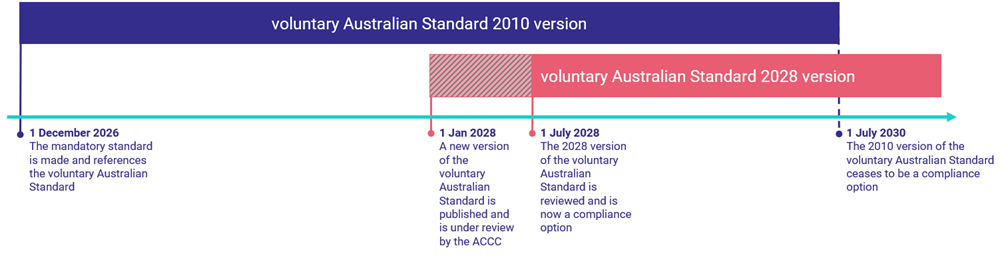
The diagram below provides a visual representation of how the dynamic referencing process would work in practice. It uses a hypothetical future update to the voluntary Australian Standard as an example only.
Diagram: Example of the dynamic referencing process for an update to the voluntary Australian Standard.
For clarity, the future update date (1 January 2028) used in this example is fictional. All dates shown in the diagram are illustrative only and should not be treated as confirmed dates. Actual dates will depend on when any future updates to the voluntary Australian Standard are made.